
Peregrine Falcon Management and Recovery Efforts
The peregrine falcon (Falco peregrinus) has long captured our imagination as a hunter of the skies, stooping on its avian prey at speeds of up to 200 mph. Peregrines are widely recognized and appreciated thanks to media coverage of nesting pairs in some of North America's major metropolitan centers, including Richmond. The introduction of peregrines into cities is part of a strategy to recover the species, following precipitous declines of its populations in the middle of the 20th century. As the Commonwealth's wildlife agency, the Department of Game and Inland Fisheries (VDGIF) has the lead role for recovery and management of peregrine falcons in Virginia. Through efforts by VDGIF and partners such as William and Mary's Center for Conservation Biology (CCB), the falcon is making a comeback in the Commonwealth.
Taxonomy and Life History
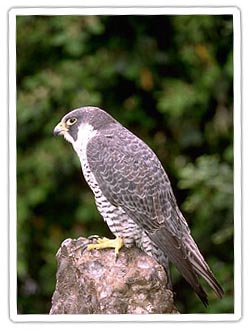
The peregrine falcon belongs to the Falconidae family of birds. With close evolutionary ties to hawks, this family counts 7 regularly-occurring species among its North American members. Peregrines are medium sized raptors with long pointed wings and a long, narrow tail. They are easily recognizable through the characteristic black crown and nape, black "sideburns", and spotted belly, all of which are features of their adult plumage. The Peregrine enjoys an essentially world-wide distribution; it is absent as a breeder only from the Amazon Basin, the Sahara Desert, the steppes of central and eastern Asia, and Antarctica. Three peregrine subspecies have been described in North America: Peale's peregrine (F. p. pealei) is the largest and darkest in color, and inhabits the island chains of the Pacific Northwest; the Arctic peregrine (F. p. tundrius) is a small, pale, highly migratory form that breeds in the arctic tundra of North America and Greenland; and the American peregrine (F. p. anatum) is intermediate in size, color, and migratory behavior. Its range extends across the continent, reaching that of tundrius in the north and extending south to north-central Mexico. The peregrines that originally inhabited western Virginia were of an anatum subpopulation known as the Appalachian peregrine. Those birds were larger and darker than others of the subspecies.
Nesting of peregrines in Virginia typically begins in March following a period of courtship. Peregrines have historically nested on the ledges of natural cliff faces in Virginia. With one known exception, they currently nest exclusively on artificial structures such as specially-constructed towers, nest boxes, bridges and tall buildings. The nest consists of a depression scraped in substrate such as dirt, sand, fine gravel, or debris. The falcons show considerable attachment to one nest location, and may return to it in successive years. The female lays 3-5 eggs at 48-72 hr intervals, and both the male and the female incubate them. Peregrines will raise only one brood per season, but may renest within a season if the eggs are lost during incubation. Incubation lasts 33-35 days. Chicks generally hatch within 24-48 hrs of one another. Young hatch covered in down and with their eyes closed. Within 5 days of hatching their mass has doubled, and they are almost fully feathered within 40 days. During this time they are cared for by the parents, who will brood them for up to 20 days and feed them. Chicks begin to fly when 40-45 days old. Although their first flight from the nest may be weak, the young are able to pursue adults to solicit food within 10 days. Peregrine falcons feed chiefly on avian prey, including shorebirds, pigeons, blackbirds, jays and other medium-sized birds. Their prey may range in size from small songbirds to large ducks. They kill prey primarily by striking them with partially-closed feet from above and catching them in mid-air as they fall. These high-speed strikes take the form of free-fall dives called "stoops". Young peregrines acquire adult plumage in their second year. Age of first breeding is variable, ranging from 1-8 years, but typically occurs at 2-3 years. Females tend to breed one year earlier than males. Peregrines may live 16-20 years in the wild.
Conservation
Although never occurring in large numbers, the American peregrine falcon was once found throughout the Appalachian Mountains of the eastern United States. In 1942, the known nesting population east of the Mississippi was estimated at around 350 pairs. Nesting in Virginia was known from 24 sites in the Allegheny and Blue Ridge Mountains and from 2 sites along the coast, in tree nests made by other birds.
After World War II, the widespread use of organochlorine pesticides such as DDT, in conjunction with human disturbance, contributed to abrupt and widespread population declines of the falcon. DDT led to the bioaccumulation of toxic residues in prey species, in turn contaminating the falcons and reducing the viability of their eggs. This resulted in the falcon's probable extirpation as a nesting species from Virginia and the eastern United States by the mid-1960s. The American and Arctic peregrine falcon subspecies were listed as endangered by the U.S. Fish and Wildlife Service (USFWS) in 1970.
Between 1975 and 1979, an Eastern Peregrine Falcon Recovery Team appointed by the USFWS developed a federal Recovery Plan whose main objective was "to restore a new self-sustaining population of peregrine falcons in the eastern United States." The plan called for protecting and managing essential nesting, wintering, and migration habitat; eliminating the environmental pollutants that originally caused most of the population declines (DDT was finally banned in 1972); protecting peregrines through law enforcement; implementing an education program to build public support for and understanding of peregrines; and releasing captive-produced falcons into the wild. To provide a source of young birds for release, a captive breeding facility was established in 1970 at the Laboratory of Ornithology at Cornell University, and the first young falcons were produced in 1973. Peregrine reintroduction in the eastern U.S. began the following year. Through efforts under the Recovery Plan, the Arctic peregrine recovered sufficiently to be delisted in 1994, and the American subspecies in 1999. Because falcons have not recovered as a nesting population in their historic mountainous range within Virginia, they remain listed as a Threatened Species under Virginia's Endangered Species Act and regulations enacted by VDGIF.
The primary method used to reintroduce falcons to the wild is called "hacking". This process involves placing 28-30 day-old birds into a protective box at a release site. Food is provided daily in the form of domestic quail or chicken, and interactions with humans are kept to an absolute minimum. Ten to 15 days later, when the young falcons are able to fly, the box is opened and the birds released. Food is provided until the birds are able to hunt successfully.
Recovery efforts in Virginia began with the hacking of young birds on the coast. Coastal release sites were initially chosen so that the young birds could disperse in areas not typically inhabited by great horned owls, known to be significant predators of young falcons. Between 1978 and 1985, 115 young peregrines were released from 8 coastal sites (including the city of Norfolk), mostly on the Eastern Shore. Birds were hacked from specially-built structures, including towers and nest boxes. Over 85% of the birds fledged from the coastal hack sites were reported to have successfully dispersed after hacking. Hacking led to the formation of the first breeding pair in more than 20 years in 1981, in the first successful nesting in 1982, and in subsequent pair formation at all of the original hack towers and other suitable sites. In the late 1980s, nesting pairs also became established at some of the major bridges on the coastal plain. This coastal population has continued to grow to its present level of approximately 20 breeding pairs.
Recovery efforts in the western part of the state began in 1983 with surveys of 13 of the 24 known historical mountain nest sites. No falcons were found. The first mountain hack sites were established in 1985 on Mt. Rogers and Clinch Mountain in southwest Virginia. Additional sites were established in George Washington and Jefferson National Forests and Shenandoah National Park in the late 1980s. All told, 131 falcons were released from 9 western Virginia sites (including downtown Roanoke) from 1985 through 1993, with a 90% success rate. The releases were complemented by the evaluation of historic and potential nest and hack sites via on-the-ground cliff monitoring (helicopter surveys were also conducted in 1991 and 1992, and most recently in 2003 and 2005). Monitoring was initiated in 1990 and coordinated by the U.S. Forest Service and National Park Service, and served to document the first falcon pair to breed in Virginia's mountains since recovery efforts began. The pair was first recorded in 1992 at Little Stony Man Mountain in Shenandoah National Park, nested successfully in 1994, and raised young twice more in the late 1990s, but did not attempt to breed following 2000.
Hacking efforts in the mountains of Virginia have resumed since 2000 as part of a strategy by VDGIF and our partners to re-establish a breeding population of the peregrine falcon in its former range. Chicks that are hacked are now homegrown, as chicks hatched in coastal bridge nests are relocated and released at mountain hacking sites. This approach benefits the Virginia falcon population as a whole because chicks from nests on bridges otherwise have a low rate of survival. Bridges lack the natural updrafts formed by air as it moves up a cliff face, so that the chick's critical first flight can be hampered if it does not catch a thermal and soar back to a suitable perch: if it fails at either task, it will end up on the ground or in the water and perish. Although the hacking of chicks typically requires that hacking efforts at a site be sustained over a period of at least 4-5 years, it has yielded success in Virginia. Annual hacks at Shenandoah National Park over the past several years are credited for the establishment of the only currently known breeding pair of falcons in western Virginia, which began nesting at Little Stony May in 2005. Additional falcon hacks using Virginia birds were begun in 2006 at the New River Gorge in West Virginia, and in 2007 at Breaks Interstate Park. Situated in Dickenson County and extending into Kentucky, the Park provides excellent cliff habitat for peregrines. Three sets of chicks from coastal plain nests were hacked there in 2007.
A discussion of peregrine falcon conservation in Virginia would not be complete without mention of the falcon pair nesting in Richmond. In 2000, Dominion Virginia Power proposed that birds be hacked on the roof of their corporate headquarters in downtown Richmond. This cooperative effort between Dominion, VDGIF, and CCB led to the hacking of falcons in Richmond for 3 successive years. This resulted in a pair becoming established in 2002. The pair established a nest on the 17th floor ledge of the First National Bank "BB&T" building and nested there from 2003-2005. Since 2006 the pair has nested on the west building of the Riverfront Plaza. The pair continues to be productive, and has contributed chicks to our hacking efforts in the mountains, including 2 chicks that were released at Breaks Interstate Park in 2007. This Richmond pair has proven to be popular not only with Richmonders, but with falcon enthusiasts around the country, who are able to view live images of the nest through our Richmond Falcon Cam.
Despite these successes, Virginia peregrines face various challenges. The current Virginia population is heavily managed and not yet self-sustaining. Repair, replacement and creation of new towers and nesting structures, translocation and hacking of chicks in the mountains, parasite control and other actions are all necessary to ensure the continued nesting success of Virginia's falcons into the foreseeable future. In addition, nest productivity has been affected by the failure of some eggs to hatch. Analysis of some "addled" eggs has revealed high levels of DDE (a byproduct of DDT) and other contaminants. Although use of such pesticides as DDT has been banned in the U.S., they are still widely used in other countries. The highly migratory behavior of peregrines and many of their prey species continues to expose peregrine falcons to these substances. VDGIF's current objectives are to maintain the coastal population and focus on recovery of a mountain breeding population. With over 100 birds released in Virginia's mountains since 1985, there may be yet-undiscovered nesting attempts occurring in Virginia's mountains. In order to document such activity, rigorous surveys for nesting pairs in Virginia's mountains will need to be conducted.
An additional objective that is intricately linked to the others is that of monitoring the annual movements and the fate of birds fledged and/or hacked in Virginia. This is being accomplished through VDGIF's FalconTrak partnership. Launched in 2001, FalconTrak uses solar-powered transmitters fitted onto peregrine falcon chicks to track their post-fledging movements via satellite. Eighteen such transmitters were fitted onto chicks hacked from downtown Richmond and from sites in the mountains, as well as on chicks hatched and fledged from nests in coastal Virginia. Nearly one half of the birds were lost in the first 10 weeks after fledging, mostly as a result of collisions with utility lines and buildings. Surviving birds, including birds that were hacked in the mountains, dispersed both north and south along the coast. This pattern of movement is probably driven by higher prey availability in coastal areas during the late fall and winter. Many of the birds spent significant periods of time in major cities such as Baltimore, Philadelphia, Trenton, New York City and Boston; barrier islands and extensive marsh complexes were also utilized. Of the 9 surviving individuals, 3 exhibited definitive southerly migration movements. One of these flew to South Carolina, and the other two made transoceanic flights from the Outer Banks of North Carolina. One of these two birds made its way to Miami, and the other eventually ended up in the Dominican Republic. Transmitter hardware malfunctions and software programming were such that only one bird fitted with a transmitter in 2001 was still being tracked in 2002. Additional falcons were fitted with transmitters between 2002 and 2004, and again in 2007. The FalconTrak partnership continues to gather information that is essential to our planning for recovery and management of peregrine falcons in Virginia.